

Jamaican Rock Iguana (Cyclura collei) release, Hillshire Hills, Portland Bight Protected Area (PBPA), Jamaica. Credit: CANARI
Supporting civil society to conserve the Caribbean’s highly threatened biologically rich ecosystems that are essential to human well-being (August 2021 – July 2027).
‘The Caribbean Islands Biodiversity Hotspot is one of 36 recognised biodiversity hotspots globally. To qualify as a biodiversity hotspot, an area must meet two strict criteria:
- Contain at least 1,500 species of vascular plants found nowhere else on Earth (known as “endemic” species).
- Have lost at least 70 percent of its primary native vegetation.
The goal of the Critical Ecosystem Partnership Fund (CEPF) is to conserve these biologically diverse and threatened ecosystems through multi-year investments that mobilise local, regional, and international partners. Its approach is to build local conservation leadership and nurture sustainable development by developing locally-driven conservation strategies and providing grants to civil society —nongovernmental, private sector and academic organisations—to implement those strategies.
About the project
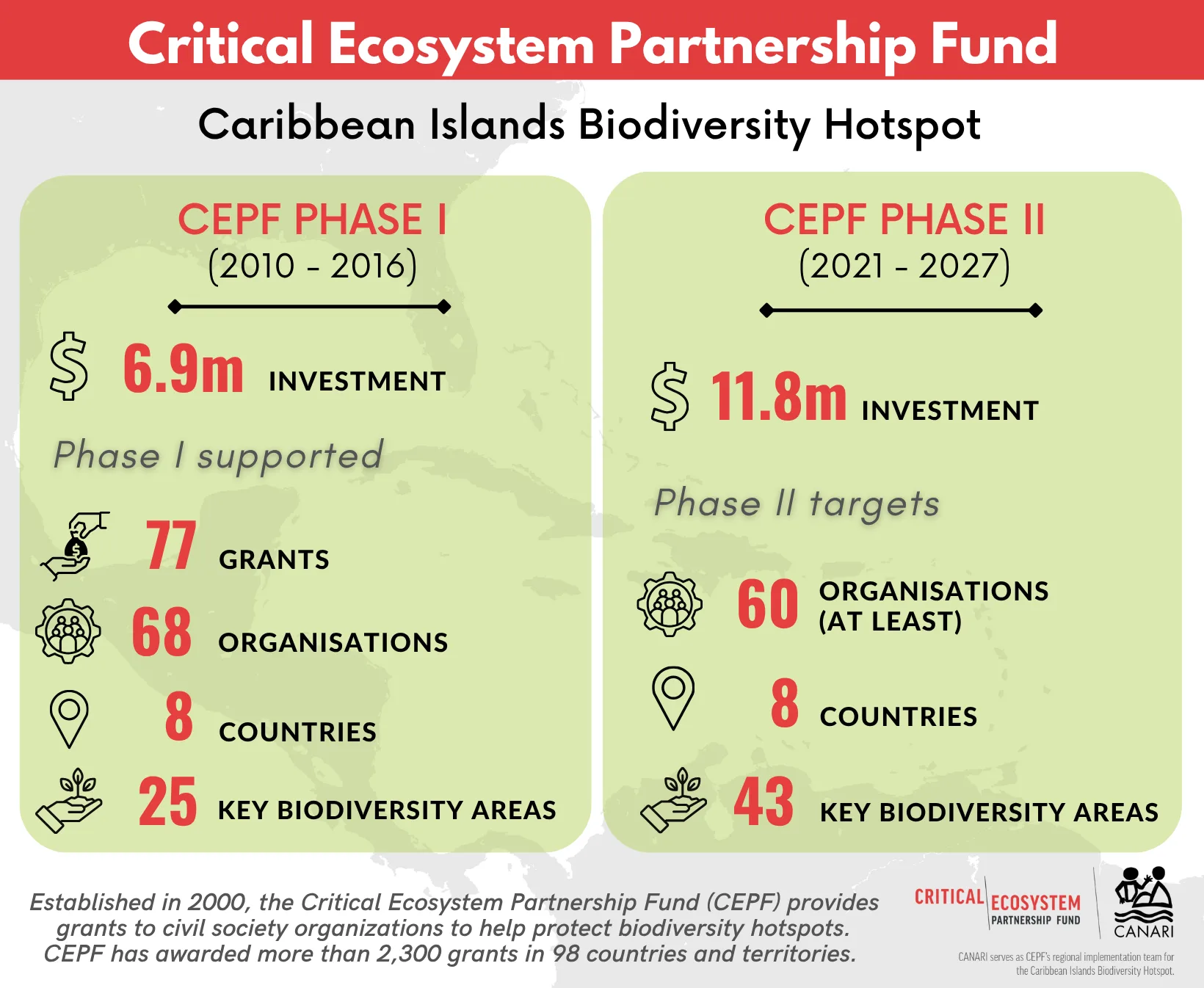
After a successful first investment in the Caribbean Islands Biodiversity Hotspot between 2010 and 2016, the Critical Ecosystem Partnership Fund (CEPF) has returned to the region for a second phase of investment from August 2021 – July 2027. CANARI is once again the Regional Implementation Team (RIT) for the CEPF Caribbean investment, which totals US$11.8 million.
How is this project benefiting the Caribbean region?
The CEPF Phase II Caribbean investment is strengthening the protection and management of globally important biodiversity within 32 priority Key Biodiversity Areas (KBAs) and seven conservation corridors in Antigua and Barbuda; The Bahamas; Dominican Republic; Haiti; Jamaica; Saint Lucia; Saint Vincent and the Grenadines. As of March 2025, 11 additional KBAs in The Bahamas, Dominica, Dominican Republic, Jamaica, Saint Lucia, and Saint Vincent and the Grenadines have been proritised for investment.
As the RIT, CANARI provides strategic leadership and local knowledge to build a broad constituency of CSOs working across institutional and political boundaries to achieve the conservation goals described in the Ecosystem Profile, the blueprint for the CEPF investment in the region (see Project-related communications).
What activities are we undertaking to achieve this?
- Grant making through small and large grants to support site-based and landscape scale conservation, the preparation and implementation of species conservation action plans, the development of innovative financing mechanisms, the promotion of sustainable livelihood alternatives, as well as increased awareness of, and support for, conservation issues among local stakeholders.
- Capacity building using a robust programme that includes training, direct one-on-one support to organisations, and mentoring.
- A complementary component uses Collaborative Social Accountability (CSA) methodologies and tools to facilitate multi-actor, multi-sectoral partnerships for conservation to co-create analyses of conservation problems and develop joint solutions. A Collaborative Social Accountability Team (CSAT), hosted at the Instituto Tecnológico de Santo Domingo (INTEC) in the Dominican Republic, in collaboration with Integrated Health Outreach (IHO) in Antigua and Barbuda, is leading this component in the Dominican Republic, Antigua and Barbuda, Jamaica and Saint Lucia. CANARI is leading this component in The Bahamas, Haiti and Saint Vincent and the Grenadines.
What have we achieved so far?
Grants awarded: 67
- 36 large grants (>$50,000.00)
- 31 small grants ($5,000.00 – $50,000.00)
Funding committed: US$10.1 million
Organisations supported: 45
- 31 local Caribbean organisations
- 14 international organisations
Geographic reach: We are supporting projects in:
- Antigua and Barbuda
- The Bahamas
- Dominican Republic
- Jamaica
- Saint Lucia
- Saint Vincent and the Grenadines
- Regional initiatives
See our Portfolio Status Infographic for an overview of the investment.
Recent project news and information
CEPF Caribbean Islands Phase II portfolio updates
- CEPF Caribbean Islands Phase II Portfolio Status Infographic
- CEPF Caribbean Islands Phase II List of Grantees
- CEPF Caribbean Islands Phase II Projects Interactive Map
Call for proposals
- Open calls
There are no open calls at this time.
- Closed calls
View previous calls for proposals here.
Recent news and blogs
- The Jamaica Gleaner – EFJ supports forest stewards (CEPF grantee – January 2026)
- Antigua News – EAG Launches Two Community Conversations Across NEMMA Villages on Proposed Wildlife Sanctuary (CEPF grantee – December 2025)
- St. Vincent Times – ‘Chatham Bay Selected as Pilot Site for Groundbreaking CSA‘ (press release – May 2025)
- Dominica News Online – ‘Critical Ecosystem Partnership Fund adds Morne Diablotin to biodiversity area list eligible for funding‘ (press release – March 2025)
- The Jamaica Gleaner – ‘Invasive Cuban Tree Frog a serious threat to Jamaica‘ (CEPF grantee feature – February 2025)
- Caribbean Magazine Plus – ‘Critical Ecosystem Partnership Fund Extends Caribbean Islands Biodiversity Hotspot Programme to 2027‘ (press release – December 2024)
- Roberto Cavada Noticias – ‘Conservadores del Caribe se reúnen en RD para evaluar proyectos del Fondo de Alianzas para los Ecosistemas Críticos‘ (press release – November 2024)
- Antigua Observer – ‘The Antiguan Racer: Appreciating and protecting it – for us’ (CEPF grantee feature – July 2024)
- World Bank News
- ‘Antiguan women scientists championing locally led conservation’ (CEPF grantee feature – July 2024)
- ‘Adapting together: A climate change journey in Jamaica’s Cockpit Country’ (CEPF grantee feature – July 2024)
- Antigua Observer – ‘Earth Day 2024: Protecting local communities in Antigua and Barbuda’ (CEPF grantee feature – April 2024)
- Searchlight St Vincent & the Grenadines – ‘SVG’s Whistling Warbler in the spotlight at BirdsCaribbean workshop’ (CEPF grantee feature – January 2023)
- Antigua & Barbuda News – ‘US$1.1 million in grants for Caribbean conservation’ (press release – September 2022)
- The Jamaica Gleaner – ‘New US$13.9-million grant supports biodiversity conservation’ (press release – September 2021)
Project-related communication
Caribbean Islands Biodiversity Hotspot Useful resources and information
Ecosystem Profile
Updated List of Prioritised Species – Revised Appendix 9
Ecosystem Profile Summary
CEPF Caribbean Hotspot Project Results Framework and Monitoring
Brochure – CEPF Phase II in the Caribbean Islands
Capacité+ Newsletter
Subscribe to our quarterly newsletter here.
Read past issues here.
Visual Stories
- “Restoring dry forests in the Caribbean Islands (StoryMap – November 2025) – ENG/SP
- “Scaling up conservation impact in the Caribbean Islands” (StoryMap – July 2025) – ENG/SP
- “Species conservation at work in the Caribbean Islands” (StoryMap – October 2023)
- “New CEPF grants awarded in the Caribbean Islands Hotspot” (StoryMap – May 2023)
- CEPF Caribbean Success Story: “Islands Without Aliens: Building Regional Civil Capacity to Eradicate Alien Invasive Species” (StoryMap – July 2022)
Infographics
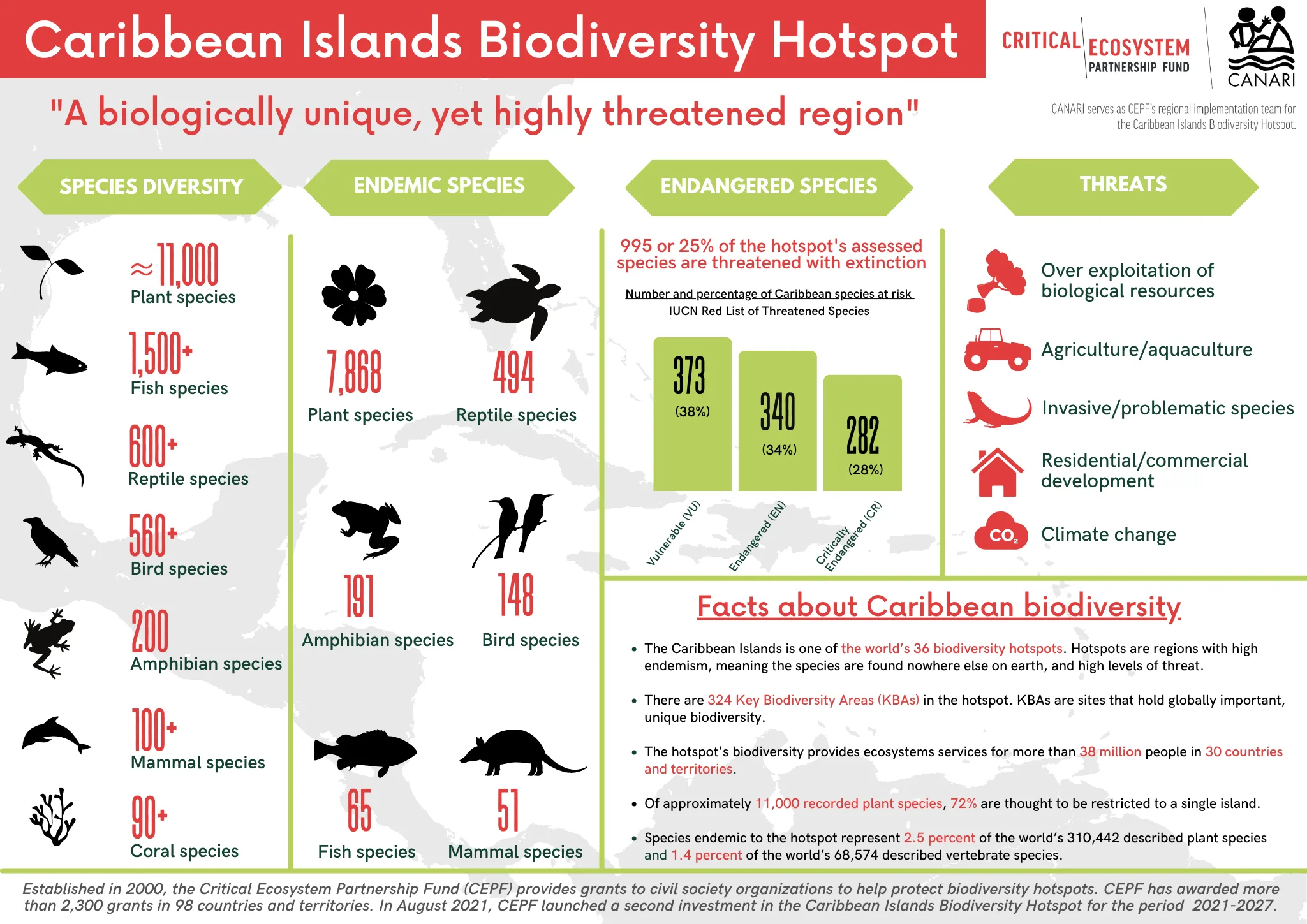
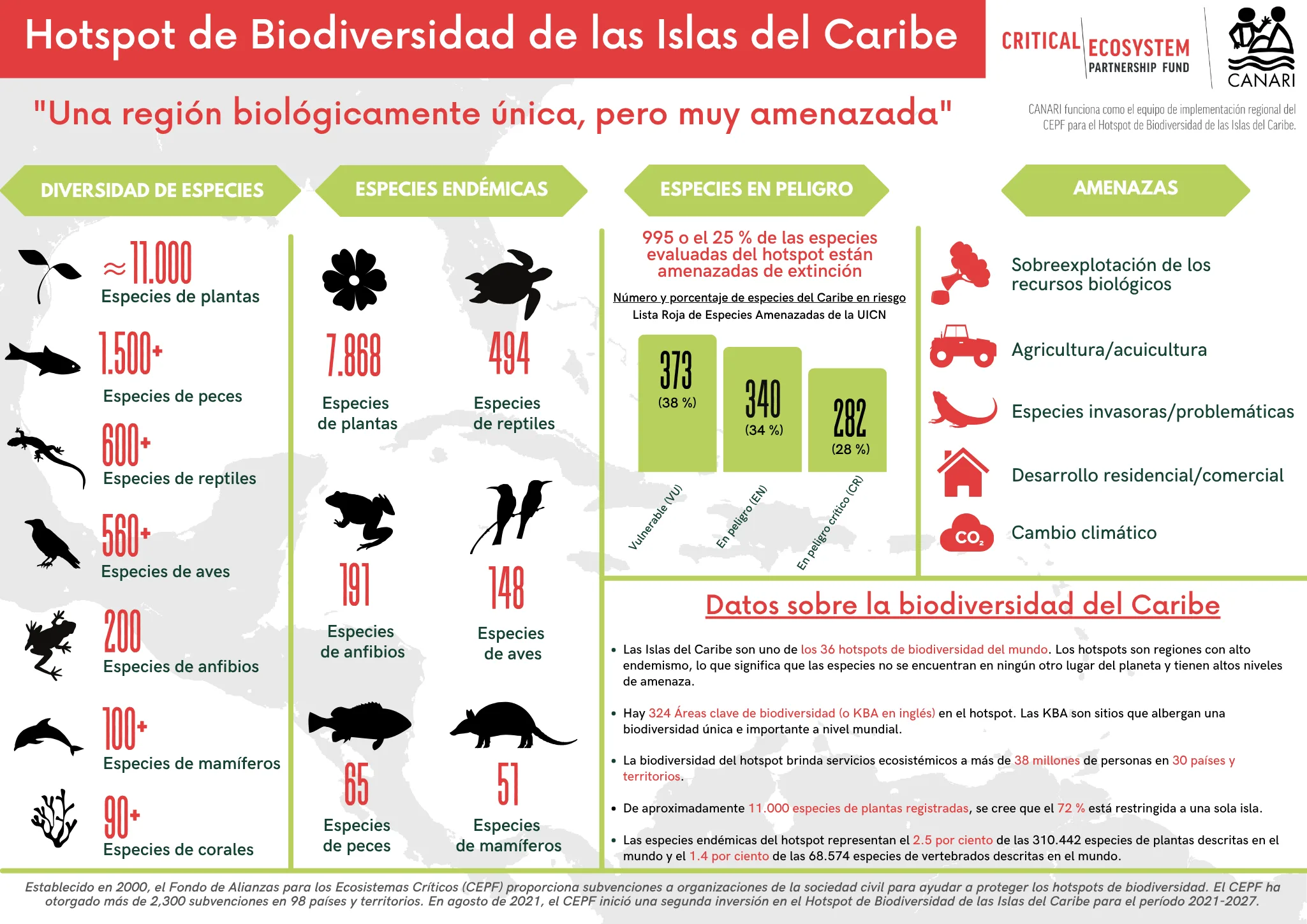
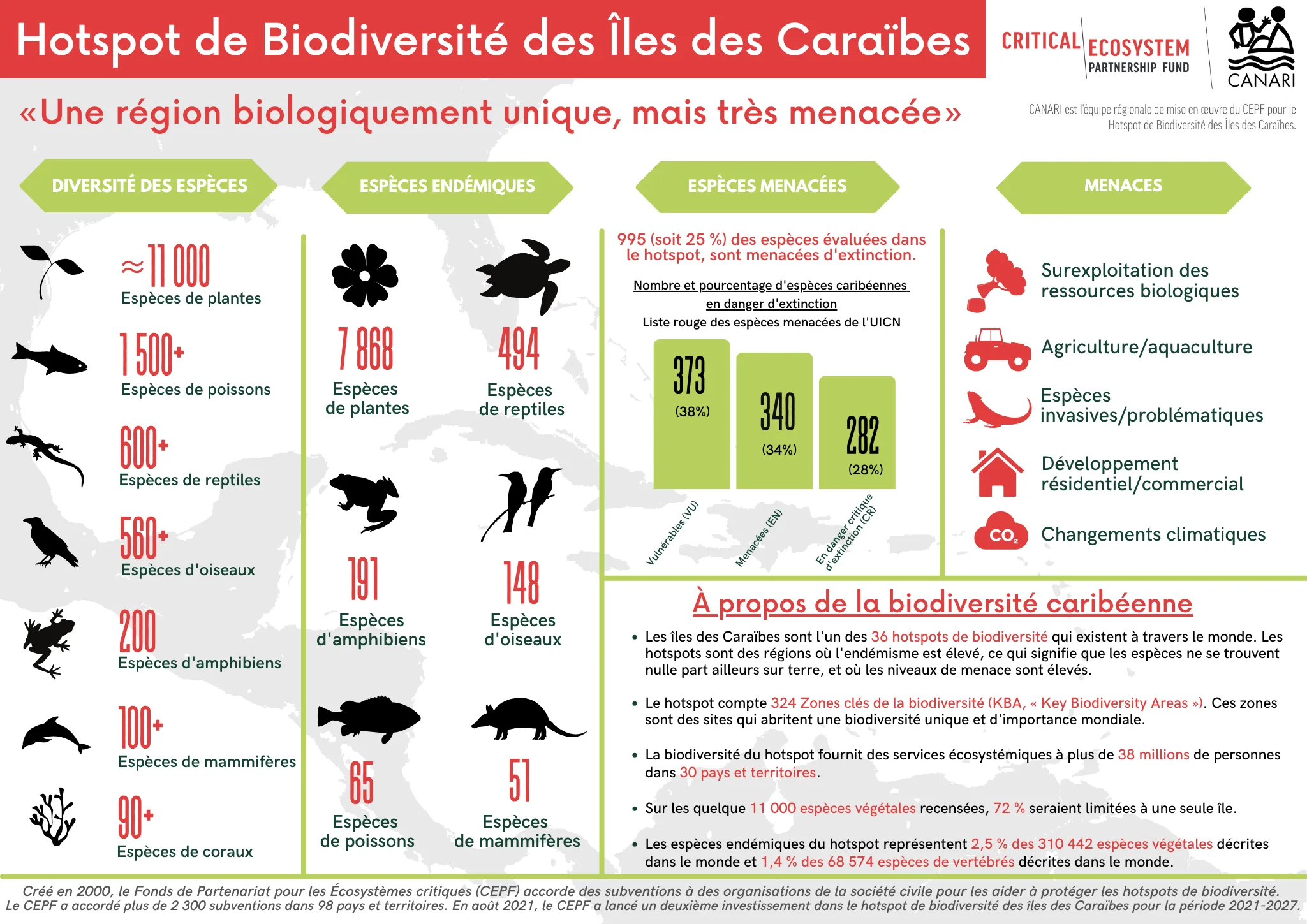
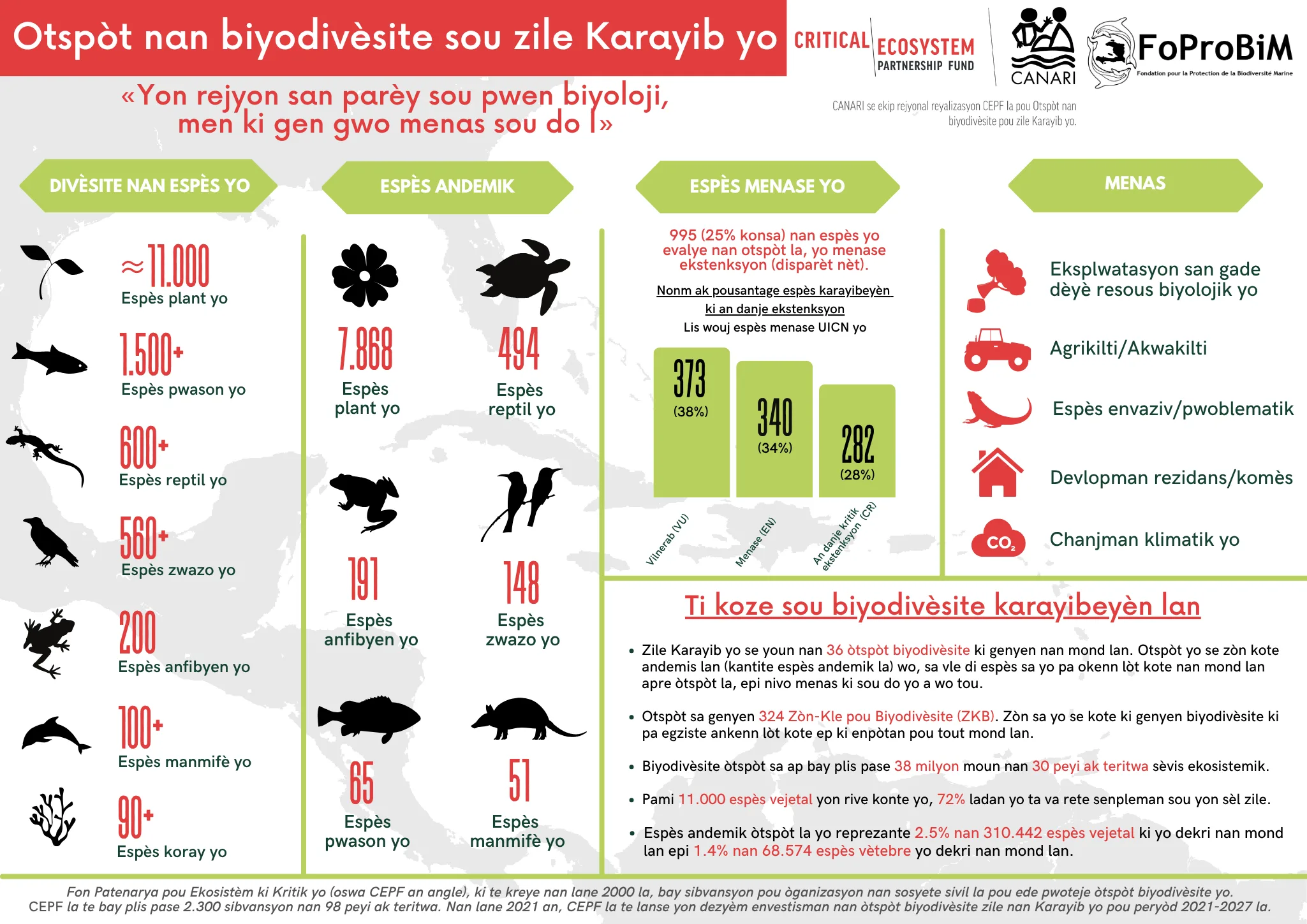
- Exploring the Caribbean Islands Biodiversity Hotspot Infographic (English, Spanish, French, Haitian Creole)
- CEPF Caribbean Islands Phase I Summary Infographic
Resources for prospective applicant and grantees
Frequently Asked Questions (FAQs)
Letters of Inquiry (LOI)
- Large grant LOI text (ENG)
- Large grant LOI text (SP)
- Small grant LOI template (ENG)
- Small grant LOI template (SP)
Training Material
- How to open an account in ConservationGrants for a large grant (Video in English)
- How to open an account in ConservationGrants for a large grant (Video in Spanish)
- How to submit a letter of inquiry for a CEPF small grant, Caribbean Islands (Video in English)
- How to submit a letter of inquiry for a CEPF small grant Caribbean Islands (PDF in English)
- How to complete a letter of inquiry for a CEPF large grant Caribbean Islands (Video in Spanish)
Meetings & Webinars
Click here to access recordings and other supporting materials.
Environmental and Social Standards
- Environmental and Social Management Framework – ESMF (ENG – PDF – 1.9 MB)
- Environmental and Social Management Framework – ESMF (SP – PDF – 2 MB)
- Environmental and Social Management Framework – ESMF (FR – PDF – 6 MB)
- Environmental and Social Standards Templates and Samples
CEPF Caribbean Phase II Gender Based Violence Service Providers Country Lists
Grievance redress mechanism
If you have concerns regarding the implementation of a CEPF-funded project, we encourage you to use our Grievance Redress Mechanism (GRM). We are committed to transparency, and your feedback is vital for effective problem resolution.
Our GRM offers a structured process for individuals and communities to voice their concerns. By using it, you can ensure that your issues are heard and addressed promptly.
Learn more about our Grievance Redress Mechanism here.
Environmental and social management framework: The purpose of the Environmental and Social Management Framework (ESMF) is to ensure that any adverse environmental and social risks and impacts arising from CEPF-funded projects are effectively avoided or, when unavoidable, minimised and mitigated as much as possible.
Download the project’s Environmental and Social Management Framework in the following languages:
- English (PDF – 1.9 MB)
- Spanish (PDF – 2 MB)
- French (PDF – 7 MB)
You can find CANARI’s environmental and social standards instruments that support ESMF compliance here.
Notification of project procurement
Click here to see a list of contracts awarded under this project, per the World Bank project procurement plan. (Last updated 18.11.2022)
More information about this project
- Download the CEPF Caribbean Islands Phase II brochure
- Visit the CEPF website: https://www.cepf.net/
- Contact Nicole Brown, Senior Technical Officer/RIT Manager, at caribbeanrit@canari.org
At-A-Glance
Aim: To improve the capacity of civil society organisations to reduce threats to globally important biodiversity in the Caribbean Islands Biodiversity Hotspot
Timeframe: August 2021 – July 2027
Budget: US$11.8M
Funded by: CEPF is a joint initiative of l’Agence Française de Développement, Conservation International, the European Union, Fondation Hans Wilsdorf, the Global Environment Facility, the Government of Canada, the Government of Japan and the World Bank.
The CEPF Phase II investment (August 2021–July 2027) in the Caribbean Islands Biodiversity Hotspot is financed through the Critical Ecosystem Partnership Fund – Caribbean Hotspot Project of the World Bank, using funds provided by the Government of Japan.

Location: Antigua and Barbuda, Dominica, the Dominican Republic, Haiti, Jamaica, Saint Lucia, Saint Vincent and the Grenadines & The Bahamas
Related Sustainable Development Goals (SDGs):

Other SDGs contributed to:
 |
 |
 |
 |
Related CANARI Programme Areas:
Related CANARI Flagship Areas:
- Local Ecosystem Stewardship
- Empowered Civil Society